A) Text 1
The genre of this text is a website, this website is about the charity action aid and is supporting fairtrade fortnight. This would be recieved by teachers who have either researched into the topic or have been told about it by other teachers who are covering fairtrade in their lessons. This text would be found by teachers who are looking for fairtrade teaching resources, they would want to engage with this text as it is very informative and offers several links to resources which can be easily found via the easily accessible drop down list system. The purpose of this text is to inform and educate as teachers would use this website to provide tools in the form of texts and work sheets for teaching school children. As a teacher the audience would expect a colourful and informative website which has a variety of choices of materials to use within lessons.
The use of the red banner at the top of the page makes the name of the charity 'act!onaid' stand out, informing the reader that this text was provided by the charity. The use of the exclamation mark in the logo for the charity actionaid gives an impression of importance and urgency, this graphology could have been chosen to represent the importance and urgency of the work carried out by actionaid. This text is well laid out which is very useful for teachers who often need to use their time efficiently, the use of the caption under each image is used to show the resource type, this makes for efficient browsing of the website. This text allows the reader to empathise with the farmers that fairtrade are aiming to help, the use of the images in this text allows people to see the type of conditions the people are in and what things supporting fairtrade does to help the workers.
B) Text 2
The genre of this text is an article, this particular article is about fairtrade and the problems with it. This text would be received by readers of the mail online or people who are interested in reading about the topic of fairtrade. The purpose of this text is to inform, it aims to inform people about the way fairtrade works and what flaws the scheme has. The audience may expect that this text is bias as the title seems to be very strongly opinionated against fairtrade.
The summary/strapline at the top of this article summarises the article and is written to intrigue the reader into continuing to read the full article. One point in this particular summary reads 'They found a widespread use of child labour with some workers aged just 10' the intensifying adverb 'just' affects the viewer's experience by making the point an example of emotive language with the age of the workers being exaggerated by the adverb, causing the reader to be impacted emotionally.
C) Comparison
Both texts use verbs, in text one the verb 'helping' is used, this word has positive connotations as it suggests a good deed. In text two the verb 'fails' is used, unlike text one this word has negative
meaning suggesting that something wasn't done correctly or that it had gone wrong. In both texts this is an example of emotive language. Text one shows happy/positive words and phrases which in turn means the audience feels positively towards it. However, text two presents sad/ negative words, ending with the audience feeling negatively towards what was talked about in the text. In text one the emotive language is enhanced by the images which show people working on fairtrade farms, these people are smiling and look happy, pushing the positive emotional impact of this text. Text two on the other hand hand has images of people working hard with little or no expression on their faces, jiving the reader a negative feeling.
Both of the websites hold different purposes. The first websites purpose is to provide a teaching resource that teachers can use to inform children about fair trade. It is a resource which is easily accessible shown by the use drop down boxes to take the reader to different parts of the website. The second websites purpose is to inform, this article informs people about the bad things that happen to do with the charity 'fairtrade'
Thursday, 31 March 2016

Thursday, 10 March 2016
Cambridge Elivate 13.5.1- 13.5.5
13.5.1
analysis of Olympic logo:
5 colours represent the five main inhabited regions of the world, with the interlinked rings representing friendship and connection.
13.5.2 Representations
''the great green con, green zealots, climate enforcers, alarmist climate science, climate McCarthyism'' These all describe believers in climate change in a powerful and negative way. The noun phrases use words like ''alarmist'' and ''enforcers'' which have violent connotations making believers in climate change seem like bullies or aggressive people. The word ''alarmist'' makes the climate seem exaggerated or over played.
13.5.3
''cool Antarctica''
Skua- Another word for thief, after the arctic skua a bird which steals eggs to eat
Weather guesser- Meteorologist, as i9t is a difficult job and weather patterns are hard to understand
13.5.4
Jonathan Freedman refers to other nationalities (European ones) as a cliché. He says it is too easy for people to accept the simple images that these phrases conjure up. ''Brits are portrayed as class-conscious binge-drinkers utterly obsessed with the war. It's a thumbnail sketch, not the whole picture... The European image of the Brit- either pukingly drunk football fan or snooty city gent, both living off of past imperial glories, sullenly resenting being in Europe rather than ruling the world it's self is a cliché. Just as Brits know that every good French man wears a striped shirt and a beret, and that ruddy-faced Germans subsist on a diet of beer and sausage, so we know precisely what all those Europeans think of us''-Guardian. The phrase ''not the whole picture'' implies that reality is far more complicated than the stereotypes.
13.3.3 Hegemony
Hegemony- The control of a powerful group has over another (the dominant group influences opinion about what is being described)
Pejorative terms- A judgemental term that usually implies disapproval or criticism.
Representations can be turned into stereotypes and can be used by powerful groups to manipulate the public into accepting attitudes and points of view that are convenient for them (Hegemony)
analysis of Olympic logo:
5 colours represent the five main inhabited regions of the world, with the interlinked rings representing friendship and connection.
13.5.2 Representations
''the great green con, green zealots, climate enforcers, alarmist climate science, climate McCarthyism'' These all describe believers in climate change in a powerful and negative way. The noun phrases use words like ''alarmist'' and ''enforcers'' which have violent connotations making believers in climate change seem like bullies or aggressive people. The word ''alarmist'' makes the climate seem exaggerated or over played.
13.5.3
''cool Antarctica''
Skua- Another word for thief, after the arctic skua a bird which steals eggs to eat
Weather guesser- Meteorologist, as i9t is a difficult job and weather patterns are hard to understand
13.5.4
Jonathan Freedman refers to other nationalities (European ones) as a cliché. He says it is too easy for people to accept the simple images that these phrases conjure up. ''Brits are portrayed as class-conscious binge-drinkers utterly obsessed with the war. It's a thumbnail sketch, not the whole picture... The European image of the Brit- either pukingly drunk football fan or snooty city gent, both living off of past imperial glories, sullenly resenting being in Europe rather than ruling the world it's self is a cliché. Just as Brits know that every good French man wears a striped shirt and a beret, and that ruddy-faced Germans subsist on a diet of beer and sausage, so we know precisely what all those Europeans think of us''-Guardian. The phrase ''not the whole picture'' implies that reality is far more complicated than the stereotypes.
13.3.3 Hegemony
Hegemony- The control of a powerful group has over another (the dominant group influences opinion about what is being described)
Pejorative terms- A judgemental term that usually implies disapproval or criticism.
Representations can be turned into stereotypes and can be used by powerful groups to manipulate the public into accepting attitudes and points of view that are convenient for them (Hegemony)
Wednesday, 9 March 2016
Analysis of text in section 13.5

Representations text 13.5.2
The genre of this text is a newspaper article, this article is by Jonathan freedman. This text would have been found in a physical copy of a newspaper or an online version . The audience of this text would be someone who reads the guardian often or someone who is researching into stereotypes and how people react to them. The primary purpose of the text is to entertain, this is achieved by the sarcastic undertones of the text. The use of the stereotypes add to the elements of entertainment as they are laughable, this would appeal to a mainly English and European audience, this is because we are able to laugh about the stereotypes set by people who do not live in England/ Europe. The second purpose is to inform, this is achieved through the word ''cliché'', the noun plays off the stereotype set about British people, informing the reader that the stereotype is not valid. The readers expectations of this text would be that this is a serious article due to the use of the word ''war'' in the title as this word has violent connotations. By saying the phrase ''not the whole picture'' the writer is implying that the reality is far more complicated than the stereotypes set by society. The opening word ''Brits'' is a contraction for 'Britons' This adjective may have been selected to engage the audience via the use of contraction.
Monday, 22 February 2016
Conversation and Representation . . .
Transcript analysis
Libby: Hi (.) I work in a hairdressers and (.) I like (.) answer the phone do the tills and stuff/
Louise: /What stuff
- This interruption could show Louise trying to be supportive of Libby and attempting to get her to talk more specifically about the 'stuff' she is referring to.
Libby: like answer the phone (.) make sure like when people have like booked an appointment I'm gonna like get it in the right time to give them like about (.) give the hairdresser the right amount of time they need to do the hair (.) and uhm yeah that's a responsibility cos obviously if I get it wrong like four people could come in at once
- The use of the filler uhm could show that Libby is feeling uncomfortable talking about her occupation, this could also be because she is the most powerful participant in this situation and does not like to be the centre of attention. She also uses the word 'like' several times, this could show nervousness or that Libby is putting thought into what she is going to say about her job. Libby uses the elision 'gonna' and slang 'cos' when explaining how her job makes her responsible, this was said toward the end of Libby's air time this could be due to the fact that she has become more comfortable talking to her peers about her roles in the workplace.
Louise: Okay
Libby: And uhm yeah (.) great
_ This could show that she has run out of things, to say about her job, despite saying the word and which implies she had more to say, and wants someone else to take over the power role she is in.
A 4 second pause then happens as the most powerful participant wants to shift the power.
Neve: *Laughs*
-This could be a sign of nervousness shown by the participant as there has been a long period of silence where the power is free for anyone to take.
Libby: So what do you want to do
- The interrogative asked by Libby was aimed at Neve during this conversation although not vocalised she was looking in my (Neve's) direction which showed who the target of the question was.
Neve: Uhm dunno
- The use of the filler 'uhm' here shows that I am thinking about how to answer the question. This is also an example of an adjacency pair as the participant knew that the question was aimed at her even though this was not vocalised.
Libby: Do you have any responsibilities
Neve: No I don't have a job (.) I'm not cool enough to have a job (3) anyone else have any responsibilities(.)
- The long pause during the speakers turn could show anxiousness to talk about the subject, the open question 'anyone else have any responsibilities' is then asked showing the participant want's to shift the power suggesting they could feel uncomfortable being the centre of attention.
Louise: Yeah I drive a car (.) that's it
Neve: You do have to have responsibility driving along(.) like looking out for other cars(.) knowing when to stop.
- This could show the participant feels more comfortable when she wasn't the most powerful participant in the conversation.
Louise: I don't wanna crash (.) get injured
- Louise's airtime is short, this could be due to the fact that she is uncomfortable being the most powerful participant or it could be because the situation the conversation was carried out under was formal as it was a set task.
Alice: I did a life guard course (.) and first aid to learn how to be a life guard
-Although the participant Alice did not contribute to the conversation earlier on, this late contribution suggests that she is shy and prefers not to hold the power in conversations.
Neve: Ooohh
- This use of filler suggests that the participant is intrigued and could also propose that she has caught on to the fact that Alice is shy in this conversation and is attempting to get her to feel more comfortable and open up.
Alice: I learnt how to treat spinal injuries
- This contribution was spoken clearly and with power, suggesting that the participant had been building up the courage to add this to the discussion, showing that Alice is a timid speaker but that once she has built up enough courage she is able to talk using the position of power.
Saturday, 13 February 2016
Gender Representation . . .
Yorkie

The yorkie chocolate bar by nestle has an interestingly unique wrapper compared to other chocolate bars, it contains the slogans ''it's not for girls'' and ''do not feed the birds''. This wrapper conforms to gender stereotypes, pointing girls out as different and deficient. This links to Lakoff's Deficit model, suggesting that women are not as powerful as men and that their speech and actions are less important than men's. The words ''do not feed the birds'' makes it seem as if women are not worthy of this food, fitting the Deficit theory. This is also an example of semantic derogation with the key word being ''birds'' referring to women, although the origin of this word was used to talk about women in a good way it seems the new use of it is equal to saying a word like 'babe'.

BIC Pens For Her
This set of pens designed for women are in the colour scheme of mostly pinks, purples and pastel colours. As if the stereotypically female colours of the pens was not enough, the packaging the pens are surrounded by has a soft purple floral design to add to the stereotypes set for women. The fact that BIC released a range of pens for women comes across as slightly offencive to the female customers of BIC as it seems to suggest that they should not be using the regular pens as they are unsuitable for females. This connects to the deficit model with men being higher in status than women, eg the normal BIC pens are male and thus BIC created pens for women.
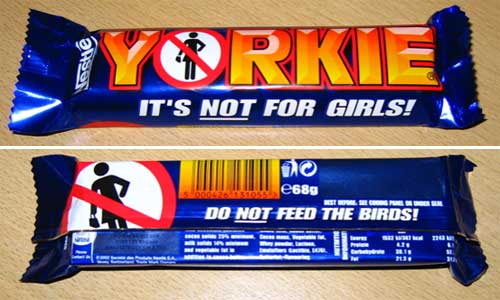
The yorkie chocolate bar by nestle has an interestingly unique wrapper compared to other chocolate bars, it contains the slogans ''it's not for girls'' and ''do not feed the birds''. This wrapper conforms to gender stereotypes, pointing girls out as different and deficient. This links to Lakoff's Deficit model, suggesting that women are not as powerful as men and that their speech and actions are less important than men's. The words ''do not feed the birds'' makes it seem as if women are not worthy of this food, fitting the Deficit theory. This is also an example of semantic derogation with the key word being ''birds'' referring to women, although the origin of this word was used to talk about women in a good way it seems the new use of it is equal to saying a word like 'babe'.

BIC Pens For Her
This set of pens designed for women are in the colour scheme of mostly pinks, purples and pastel colours. As if the stereotypically female colours of the pens was not enough, the packaging the pens are surrounded by has a soft purple floral design to add to the stereotypes set for women. The fact that BIC released a range of pens for women comes across as slightly offencive to the female customers of BIC as it seems to suggest that they should not be using the regular pens as they are unsuitable for females. This connects to the deficit model with men being higher in status than women, eg the normal BIC pens are male and thus BIC created pens for women.
Tuesday, 2 February 2016
Charity Language Representation. . .
RSPB (Royal Society for the Protection of Birds)

This text has interesting graphology as when the webpage is first opened the reader is greeted by a large photograph of a bee, this mixed mode makes the website appealing to younger audiences as it is colorful and contains several images. Although this web page may appeal to younger audiences it also contains a variety of information about projects which the charity have carried out. Owing to the fact that the RSPB is a large and widely respected charity it has a large amount of organisational power. At the top of this website there are various clickable tabs which will take the visitor to different links surrounding information about the Royal Society for the Protection of Birds.
The next section of the page is titled ''Our mission'' this is surrounded by the vivid colour blue, this colour was chosen as blue is the first colour the human eye sees, making this part of the text very attractive. Under the title ''Our mission'' the text reads ''Our birds and wildlife are increasingly vulnerable in a rapidly-changing world. Together, we will create bigger, better, more joined-up spaces for nature to save our wildlife, and our shared home.'' This makes the reader feel included as the words ''our'' ''together'' ''we'' all give the reader a sense of responsibility and belonging with the rspb, this could be a use of the politeness strategy positive face.
As this particular text is a webpage the majority of the people visiting this page will be visiting it because they are already aware of the charity and would like to find out more about what the rspb do for wildlife or to find out about the reserves across the UK. The other main reason someone would look at this website is for research, eg students or children researching about the aims of the charity for school/college/uni work.
 At the very top of this page the RSPBs logo and slogan is shown. The slogan reading ''giving nature a home'' personifies nature as if it is like a homeless person which the public can help by supporting the RSPB. This appeals to the more sensitive side of the audience in turn persuading them to donate to/ join the Royal Society for the Protection of Birds.
Link to the website- https://ww2.rspb.org.uk/whatwedo/
Subscribe to:
Posts (Atom)